

Earnouts are a staple of life sciences M&A. They bridge valuation gaps, allocate regulatory risk, and align incentives around post-closing development. But they also generate some of the most contentious post-deal litigation—especially when the regulatory landscape shifts.
A recent decision from the Delaware Supreme Court in the dispute between Johnson & Johnson and Fortis Advisors LLC (as representative for former stockholders of Auris Health) provides critical guidance on how far Delaware courts will go in using the implied covenant of good faith and fair dealing to “save” an earnout when regulatory assumptions prove wrong.
The ruling reins in an earlier decision from the Delaware Court of Chancery and offers a clear message: Delaware courts will not rewrite milestone language simply because the parties could have drafted it differently.
The Deal and the Regulatory Assumption
J&J acquired Auris Health in a transaction featuring:
- $3.4 billion in upfront cash
- Up to $2.35 billion in earnouts tied to ten milestones
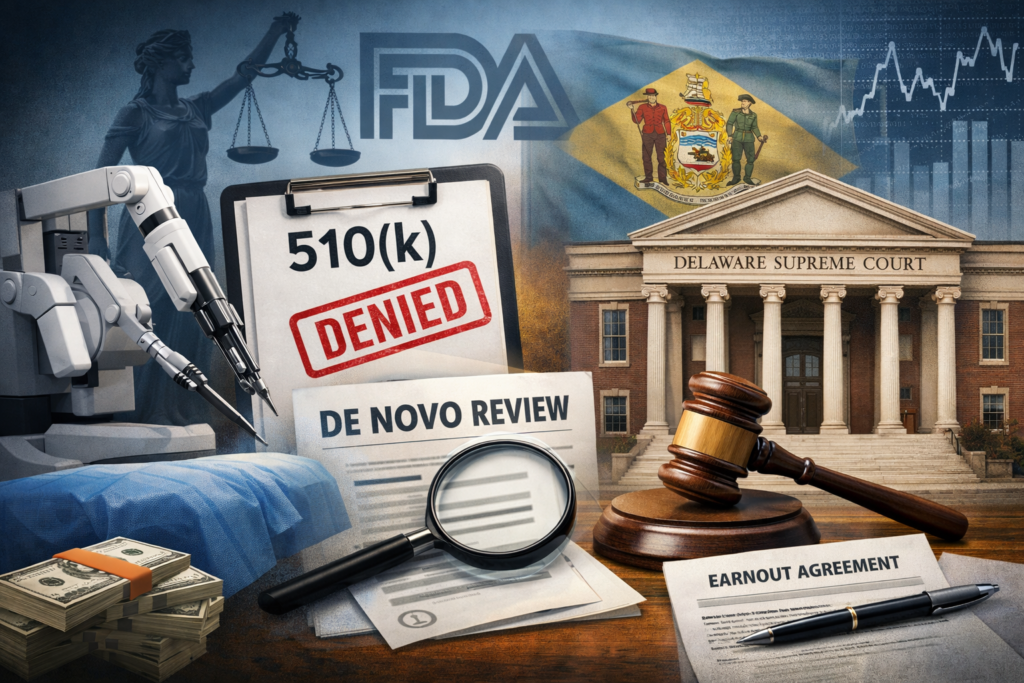
- Eight of those milestones expressly conditioned on obtaining 510(k) premarket notification from the Food and Drug Administration (FDA)
The 510(k) pathway is generally faster and less burdensome than other FDA routes because it relies on demonstrating “substantial equivalence” to an existing predicate device.
After closing, however, the FDA determined that Auris’s robotic surgical devices were no longer eligible for clearance through 510(k). Instead, they would require a more rigorous de novo classification pathway.
J&J took the position that because the milestones were explicitly tied to 510(k) clearance, the regulatory shift excused it from continuing development toward those milestones.
The Chancery Court: Implied Covenant Fills the Gap
The Court of Chancery disagreed—at least in part.
It held that the implied covenant of good faith and fair dealing required J&J to pursue a de novo pathway for the first regulatory milestone. In the court’s view, the parties would have expected the buyer to continue pursuing approval through a functionally similar route, particularly where the difference in time and cost was thought to be immaterial.
That ruling raised alarms for buyers: it suggested that even highly specific milestone language might be judicially expanded if a court believed the economic “spirit” of the deal demanded it.
The Delaware Supreme Court: No Gap, No Implied Obligation
The Delaware Supreme Court reversed that key holding.
1. No “Gap” to Fill
The implied covenant only applies where there is a true contractual gap—a situation the parties failed to address but would have resolved had they considered it.
Here, there was no gap. The agreement did not refer generically to “regulatory approval.” It repeatedly and specifically required:
“510(k) premarket notification.”
That level of precision was dispositive. The Court held that invoking the implied covenant to require pursuit of de novo approval would effectively rewrite the contract, not fill a gap.
2. Foreseeability Matters
The Court emphasized that a regulatory shift from 510(k) to de novo, while perhaps unlikely, was not unforeseeable at signing. Because the risk was knowable and could have been allocated expressly, it was not appropriate to use the implied covenant to shift it after the fact.
3. Immateriality Doesn’t Save You
The Chancery Court had reasoned that the difference between 510(k) and de novo for the first milestone would have only an “immaterial effect” on cost and timing. The Supreme Court rejected that logic:
Even an immaterial difference cannot override a clear contractual condition.
Why the Other Milestones Survived
Interestingly, the Court treated the remaining seven regulatory milestones differently.
Once a product obtains de novo authorization, it can potentially serve as its own predicate for future 510(k) submissions. Because of that regulatory structure, the Court held that J&J still had to use commercially reasonable efforts to pursue 510(k) clearance for the later milestones—including seeking de novo authorization where necessary to enable those later 510(k)s.
So while the buyer escaped liability for the first milestone, it remained on the hook for efforts tied to the others.
Commercially Reasonable Efforts Still Has Teeth
The Supreme Court also affirmed that J&J breached its express “commercially reasonable efforts” covenant, which was defined by reference to how J&J treats its own “priority medical device products.”
This reinforces a separate lesson:
Even when milestone triggers are narrowly drafted, efforts clauses are independently enforceable and will be measured against the buyer’s real-world internal practices.
Exclusive Remedy ≠ Anti-Reliance
Finally, the Court upheld the Chancery Court’s ruling that an exclusive remedy clause does not substitute for a properly drafted anti-reliance provision. If buyers want to cut off extra-contractual fraud claims, they still need explicit anti-reliance language running against the seller.
Practical Takeaways for Life Sciences Deals
1. Specificity Cuts Both Ways
If you tie a milestone to a particular regulatory pathway, Delaware courts will enforce that choice literally—even if a nearly equivalent pathway later becomes the only viable route.
Drafting tip: If flexibility is desired, use formulations like:
- “510(k) or other substantially equivalent regulatory pathway”
- “FDA authorization sufficient to permit commercial marketing in the United States”
2. Regulatory Pathway Risk Is Allocable
Courts will not treat major regulatory changes as “unforeseen” simply because they are low probability. If pathway risk matters, address it directly.
3. Implied Covenant Is a Backstop, Not a Safety Net
Post-J&J v. Fortis, the implied covenant cannot be used to:
- Convert specific triggers into general ones
- Rebalance economics because assumptions changed
There must be a true silence in the contract—not just a bad outcome for one side.
4. Efforts Covenants May Drive Liability More Than Milestones
Even if a milestone becomes technically unreachable, a poorly managed development program can still breach a commercially reasonable efforts clause.
5. Don’t Forget Standalone Anti-Reliance Language
An exclusive remedy clause alone will not shield against fraud claims based on extra-contractual statements.
Bottom Line
For founders, investors, and deal counsel in medtech and biotech:
Delaware will enforce the milestone you wrote—not the milestone you wish you had written.
Earnouts can effectively allocate scientific and regulatory risk, but only if the drafting matches the real-world contingencies. If a particular FDA pathway is mission-critical, say so. If flexibility is intended, build it in expressly. Courts will not do that work for you after closing.